
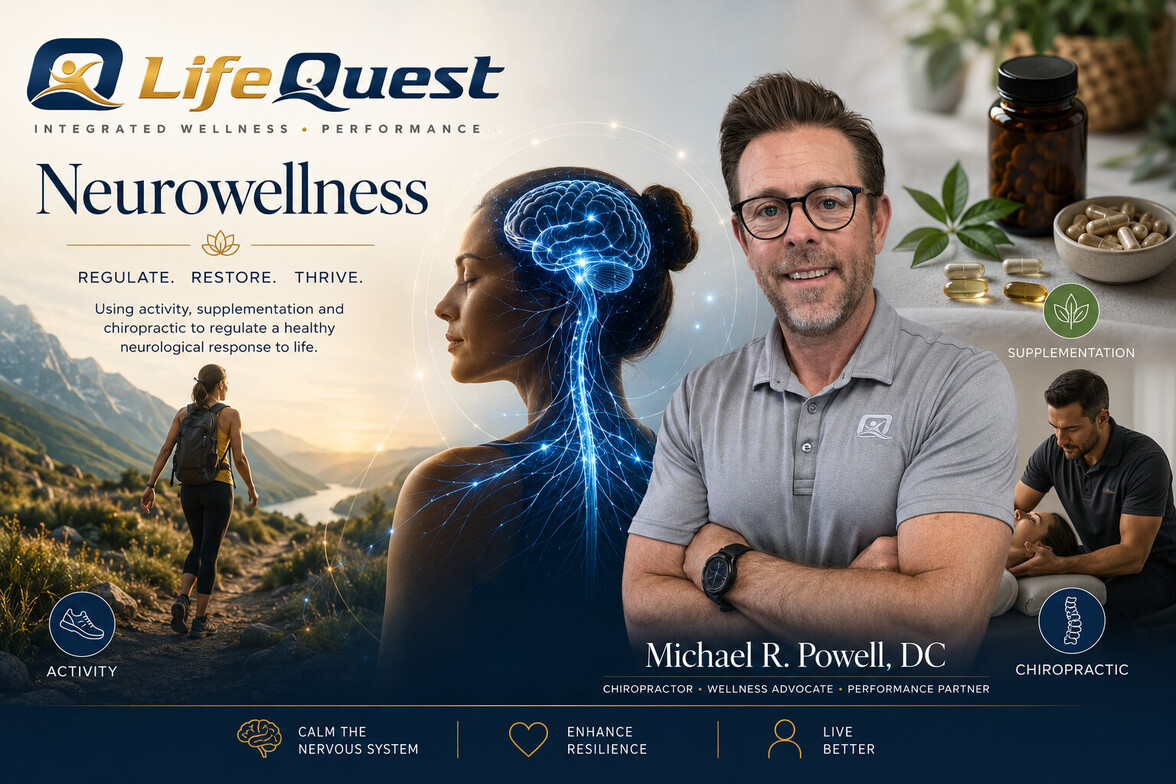
At Life Quest Integrated Wellness and Performance, we treat the nervous system as the operating system of human performance. Every workout you recover from, every decision you make under pressure, every night of deep sleep, every adaptation your body produces — all of it runs through the central and autonomic nervous systems. When that system is dysregulated, no amount of training, supplementation, or willpower can compensate for long. When it’s tuned, everything else compounds.
Neurowellness is the deliberate practice of regulating the nervous system — downshifting it when it’s stuck in overdrive, building its capacity to adapt under stress, and protecting the neural tissue itself. Here’s how we think about it clinically, and what we recommend to our patients who want to perform at a high level without burning out.
The Modern Problem: A Nervous System Stuck in “On”
Your autonomic nervous system has two primary branches: the sympathetic (fight-or-flight) and parasympathetic (rest-digest-recover). They’re designed to oscillate. The sympathetic branch surges when you train, present in a meeting, or face a deadline. The parasympathetic branch takes over when you’re cooking dinner, sleeping, or recovering between hard efforts.
The problem isn’t sympathetic activation. The problem is the failure to come back down. Chronic stress, poor sleep, screen overuse, under-recovery, and spinal dysfunction all keep the system tilted toward sympathetic dominance — which shows up as poor sleep, brain fog, plateaued training, blunted libido, gut issues, anxiety, and an immune system that quits at the worst possible time.
Three categories of intervention move the needle: targeted supplementation, deliberate physiological adaptations, and direct nervous system care.
Top 3 Supplements That Downregulate the Central Nervous System
These three are first-line because they have strong mechanistic data, large bodies of clinical research, and an excellent safety profile.
1. Magnesium Glycinate
Magnesium is involved in hundreds of enzymatic reactions, but its CNS-calming effect comes from two specific mechanisms. First, it acts as an agonist at the GABA-A receptor — the same receptor system targeted by benzodiazepines — which is the brain’s primary inhibitory “brake pedal.” Second, it sits inside the NMDA receptor and blocks glutamate, the primary excitatory neurotransmitter, from overactivating cortical neurons.
Translation: magnesium simultaneously turns up the brakes and turns down the gas. Research has also shown that magnesium supplementation can reduce cortisol, supporting HPA-axis regulation and improving sleep architecture. The glycinate form is preferred for nervous system work because glycine itself is an inhibitory neurotransmitter and the chelate is well-absorbed without the GI effects of magnesium oxide or citrate.
Typical dose: 200–400 mg elemental magnesium, taken 30–60 minutes before bed.
References: Kirkland et al., “The Role of Magnesium in Neurological Disorders,” Nutrients (2018); Maier et al., “Magnesium and the Brain: A Focus on Neuroinflammation and Neurodegeneration,” International Journal of Molecular Sciences (2023).
2. L-Theanine
L-theanine is an amino acid found almost exclusively in green tea, and it’s one of the few compounds that produces calm without sedation. EEG studies consistently show that a 200 mg dose increases frontal alpha brain wave activity — the same wave pattern observed in meditation and “relaxed wakefulness.” A 2021 randomized, triple-blind, placebo-controlled crossover trial found that a single 200 mg dose significantly increased frontal alpha power and significantly reduced salivary cortisol in response to an acute stress test compared to placebo.
Mechanistically, L-theanine modestly raises GABA, serotonin, and dopamine while blunting glutamate binding at NMDA receptors. It’s our go-to for patients who need to stay sharp under stress — pre-presentation, pre-competition, or anytime sympathetic tone needs to come down without sacrificing cognition.
Typical dose: 100–200 mg as needed for acute stress, or 200 mg in the evening to support sleep onset.
References: Williams et al., “A Randomized, Triple-Blind, Placebo-Controlled, Crossover Study to Investigate the Efficacy of a Single Dose of AlphaWave L-Theanine on Stress in a Healthy Adult Population,” Neurology and Therapy (2021); Nobre et al., “L-theanine, a natural constituent in tea, and its effect on mental state,” Asia Pacific Journal of Clinical Nutrition (2008).
3. Ashwagandha (Withania somnifera)
Ashwagandha is the most-studied adaptogen in modern literature, and its primary value is HPA-axis modulation. Multiple randomized controlled trials have demonstrated reductions in serum cortisol of roughly 20–28% in chronically stressed adults over 60 days, alongside meaningful improvements in perceived stress scores, sleep quality, and anxiety. A 2019 RCT in 60 adults using a standardized extract (Shoden, 240 mg/day) confirmed both cortisol reduction and HPA-axis modulation as the proposed mechanism. Standardized extracts of withanolides also influence GABAergic signaling, which contributes to the sleep and anxiolytic benefits.
A caveat we share with patients: ashwagandha is best cycled rather than taken indefinitely. Recent case reports describe HPA-axis suppression with chronic high-dose use, so we typically recommend 8–12 week courses with breaks.
Typical dose: 300–600 mg per day of a standardized extract (KSM-66 or Sensoril), ideally with food.
References: Salve et al., “Adaptogenic and Anxiolytic Effects of Ashwagandha Root Extract in Healthy Adults: A Double-Blind, Randomized, Placebo-Controlled Clinical Study,” Cureus (2019); Lopresti et al., “An investigation into the stress-relieving and pharmacological actions of an ashwagandha (Withania somnifera) extract: A randomized, double-blind, placebo-controlled study,” Medicine (2019).
Top 3 Adaptations That Influence CNS Stability
Supplements support the nervous system. Adaptations build it. These three are the highest-leverage practices we coach into patient routines.
1. Deliberate Cold Exposure
A cold plunge or cold shower triggers a sharp sympathetic spike — heart rate, norepinephrine, and blood pressure all rise within seconds. The training effect comes from what happens next: a powerful parasympathetic rebound mediated by the vagus nerve, particularly through the trigeminal-vagal reflex when the face is submerged. Repeated exposure trains the nervous system to shift between sympathetic and parasympathetic states more efficiently, which shows up as higher resting heart rate variability (HRV) — the most reliable marker of vagal tone and autonomic resilience.
Three to five sessions per week of 2–5 minutes at 50–59°F is the typical protocol. Pair it with slow nasal breathing during and after the plunge to amplify the parasympathetic rebound.
2. Slow Diaphragmatic Breathing
Breathing is the only autonomic function you can hijack voluntarily, which makes it the single most accessible nervous system tool you have. Slow breathing at 4–6 breaths per minute (with the exhale longer than the inhale) directly stimulates the vagus nerve, raises HRV, and shifts the autonomic balance toward parasympathetic dominance. Box breathing (4-4-4-4), used by special operations and elite performers, accomplishes the same thing through structured rhythm.
Five minutes, twice daily — morning and pre-sleep — is enough to produce measurable changes in resting vagal tone within a few weeks. It’s also the fastest in-the-moment tool we know of for breaking out of acute sympathetic activation.
3. Zone 2 Aerobic Training
Most people associate cardiovascular training with stress, but Zone 2 (the conversational pace where you’re working but can still hold a sentence) is one of the most powerful parasympathetic-building modalities available. It increases mitochondrial density, improves vagal tone, lowers resting heart rate, and raises HRV. It’s also the only aerobic intensity that doesn’t add meaningful sympathetic stress to an already-overtaxed system.
Three to four sessions per week of 30–60 minutes builds an aerobic base that downregulates baseline sympathetic tone across the entire day — not just during exercise.
The Neuroprotective Role of Creatine Monohydrate
Creatine is best known as a strength and performance supplement, but the more interesting story is what it does in the brain. Neurons are second only to muscle in energy demand, and creatine serves as a phosphocreatine energy buffer that maintains ATP availability under load — whether that load is a max-effort lift, a sleep-deprived workday, or the metabolic stress of aging.
Supplementation has been shown to increase brain creatine content by roughly 5–15%, with downstream effects that include improved working memory, faster processing speed, and better cognitive performance under stressors like sleep deprivation and hypoxia. McMorris et al. demonstrated that creatine supplementation significantly improved cognitive and psychomotor performance after sleep deprivation. A 2024 systematic review and meta-analysis confirmed cognitive benefits across multiple adult populations.
Beyond performance, creatine demonstrates genuine neuroprotective properties:
It mitigates glutamate-induced oxidative and nitrosative stress on neurons
It stabilizes mitochondrial function and reduces neuroinflammation
It supports BDNF (brain-derived neurotrophic factor) expression through the muscle-brain axis
Preliminary evidence suggests benefit in neurodegenerative conditions including Parkinson’s, Huntington’s, and Alzheimer’s, as well as recovery from concussion and traumatic brain injury
Brain uptake is slower than muscle uptake because creatine doesn’t cross the blood-brain barrier readily, which is why some researchers recommend a higher dose (10 g/day) when cognitive benefit is the primary goal. For most adults seeking both performance and brain support, 5 g/day of plain creatine monohydrate — the most-studied and least expensive form — is the standard.
References: Forbes et al., “Effects of Creatine Supplementation on Brain Function and Health,” Nutrients (2022); Candow et al., “Creatine supplementation and the muscle-brain axis,” Frontiers in Nutrition (2025); Chun et al., “Effects of 6 weeks of high-dose creatine monohydrate supplementation with or without guanidinoacetic acid on cognitive function,” Journal of the International Society of Sports Nutrition (2025); Gordji-Nejad et al., “Single dose creatine improves cognitive performance and induces changes in cerebral high energy phosphates during sleep deprivation,” Scientific Reports (2024).
The Missing Piece: Chiropractic Care and Autonomic Regulation
Supplements and adaptations are powerful, but they work on a system — and the system itself needs to be functioning well. This is where chiropractic care fits into neurowellness in a way that’s often underappreciated.
The spine isn’t just a structural column. It’s the housing for the central nervous system, and the autonomic nervous system runs along its length. The sympathetic chain ganglia sit directly alongside the thoracic and lumbar spine. The parasympathetic outflow — particularly the vagus nerve, the master regulator of rest-and-digest function — originates in the brainstem and is heavily influenced by upper cervical biomechanics. When spinal segments are dysfunctional, the neural signaling that travels through and alongside them is affected.
A growing body of research has examined what happens to autonomic function after chiropractic adjustment. The findings consistently show that specific spinal manipulation can modulate the autonomic nervous system, increasing parasympathetic (vagal) activity and reducing sympathetic dominance. Studies using HRV — the gold-standard non-invasive measure of autonomic balance — have documented improvements in vagally-mediated HRV metrics following both single sessions and longer courses of chiropractic care. Case series have also documented reductions in anxiety symptoms (measured by the Hamilton Anxiety Scale) and improvements in autonomic function in patients receiving consistent chiropractic care.
The clinical translation is straightforward: when we adjust a patient whose nervous system is locked in fight-or-flight, we frequently see the immediate physiological signs of parasympathetic shift — slower breathing, softer muscle tone, sometimes the deep exhale that signals the brain has finally stood down. Over a course of care, those acute shifts compound into a more resilient baseline.
This is why we describe chiropractic care at Life Quest as nervous system care, not back pain care. Pain relief is often a byproduct. The deeper outcome is a nervous system that’s better able to oscillate — that can ramp up when you need to perform and stand down when you need to recover.
Putting It Together
A high-performance life isn’t built on doing more. It’s built on a nervous system that can handle more — and then recover from it. The integration looks like this:
Downregulate with magnesium glycinate, L-theanine, and (cyclically) ashwagandha
Adapt through deliberate cold exposure, slow diaphragmatic breathing, and Zone 2 training
Protect the neural tissue itself with daily creatine monohydrate
Regulate the system directly through consistent chiropractic care
This is the foundation we build with patients at Life Quest Integrated Wellness and Performance. If you’re noticing that you can’t get out of overdrive — poor sleep, blunted recovery, training plateaus, persistent low-grade anxiety — your nervous system is telling you something. We can help you listen.




.png)
