
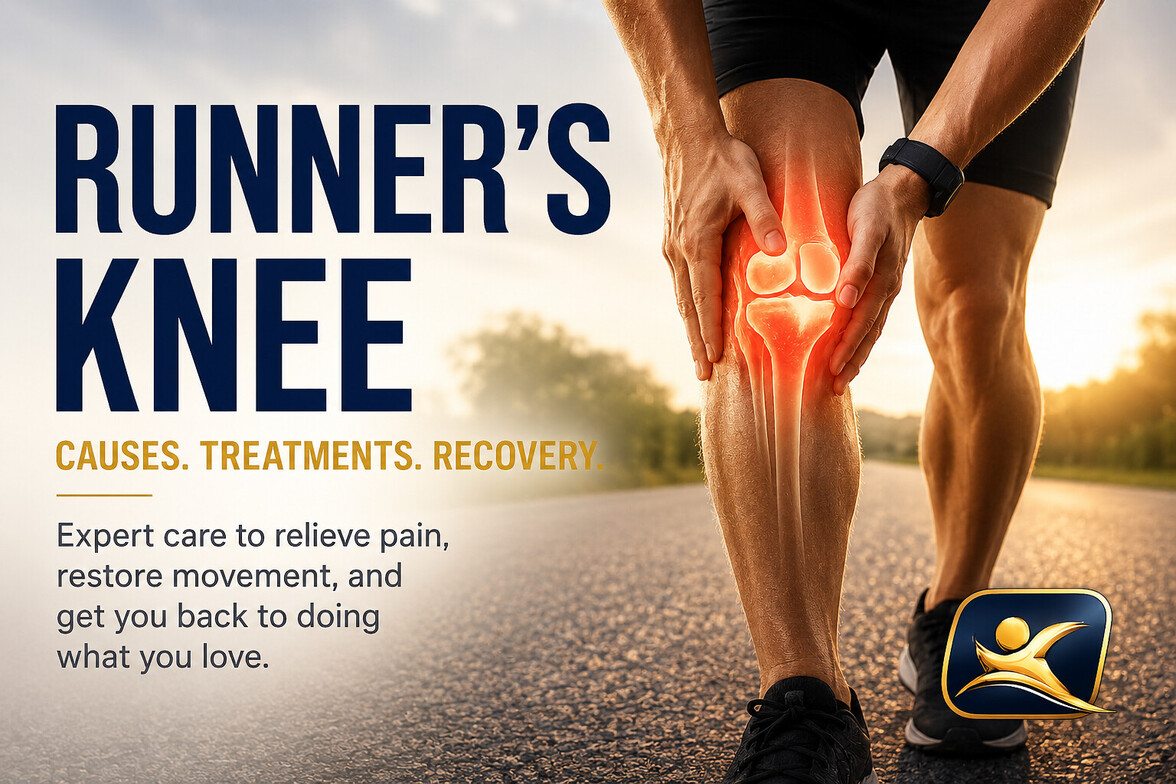
If you’re a runner, chances are you’ve felt it before.
That nagging ache around the kneecap when going up stairs. The stiffness after a long run. The pain that starts mild, but slowly begins to affect every workout, every squat, every step getting out of the car.
Most runners assume it’s “just part of running.”
It’s not.
At Life Quest , we see Runner’s Knee every single week in runners, CrossFit athletes, hockey players, golfers, and active adults throughout the Alexandria lakes area. More importantly, we understand why it happens, why it keeps coming back, and how to actually fix the problem instead of simply masking symptoms.
What Is Runner’s Knee?
“Runner’s Knee” is the common term for Patellofemoral Pain Syndrome (PFPS). It refers to irritation and inflammation occurring between the kneecap (patella) and the groove it tracks through on the femur.
Typically, pain develops:
-
Around or behind the kneecap
-
During running or after running
-
Walking downstairs
-
Squatting or lunging
-
Sitting for prolonged periods
-
Jumping or landing activities
Many runners describe it as a dull ache early on that gradually becomes sharper and more limiting over time.
The problem is that the knee is often not the true source of dysfunction.
What Actually Causes Runner’s Knee?
Most cases of Runner’s Knee are caused by poor movement mechanics and overload over time.
At Life Quest, we rarely look at the knee in isolation.
Instead, we evaluate:
-
Hip stability
-
Glute activation
-
Foot mechanics
-
Pelvic control
-
Running mechanics
-
Ankle mobility
-
Core stability
-
Muscle imbalances
-
Training volume and recovery capacity
Here’s what commonly happens:
When the hip becomes weak or unstable, the femur rotates inward during running. That subtle collapse changes the tracking pattern of the kneecap. Over thousands of repetitive steps, irritation builds.
Add poor ankle mobility, flat feet, weak glutes, inadequate recovery, or overtraining, and the stress on the knee multiplies quickly.
This is why rest alone rarely fixes the problem long term.
The symptoms calm down temporarily, but the dysfunctional movement pattern remains.
Then the pain returns.
Why Runner’s Knee Progresses If Left Untreated
One of the biggest mistakes runners make is trying to “push through” knee pain.
Early-stage Runner’s Knee is usually manageable. But over time, untreated dysfunction creates progressive stress and tissue irritation.
As the condition advances, runners often experience:
-
Reduced mileage tolerance
-
Pain during daily activities
-
Loss of strength and stability
-
Altered gait mechanics
-
Compensation injuries in the hips, low back, or opposite leg
-
Chronic inflammation
-
Cartilage irritation behind the kneecap
Eventually, the body begins adapting around pain.
That adaptation is where performance starts declining.
The runner who once loved training now avoids hills, cuts runs short, or stops exercising altogether because every workout becomes frustrating.
We believe active people deserve better answers than:
“Just stop running.”
How We Treat Runner’s Knee at Life Quest
At Life Quest, our approach is different because we combine multiple disciplines under one roof to help patients recover faster and perform better.
With decades of experience treating athletes and sports injuries — from endurance athletes to hockey players and CrossFit competitors — we understand that successful treatment requires more than simply chasing symptoms.
Our goal is to identify the WHY behind the pain.
Comprehensive Functional Evaluation
Every case begins with a detailed movement and functional assessment.
We evaluate:
-
Squat mechanics
-
Single-leg stability
-
Hip control
-
Running-related movement dysfunction
-
Joint mobility
-
Muscle activation patterns
-
Tissue irritation
-
Recovery limitations
This allows us to build a treatment plan specific to the individual instead of using a generic “rest and ice” approach.
Chiropractic and Joint Mobility Treatment
Restricted joint motion in the pelvis, hips, knees, or ankles can dramatically alter running mechanics.
Our chiropractic treatment focuses on restoring proper joint motion and improving movement efficiency throughout the entire kinetic chain.
When joints move better:
-
Muscles activate more efficiently
-
Stress distribution improves
-
Compensation patterns decrease
-
Running mechanics improve
-
Recovery accelerates
Shockwave Therapy for Chronic Knee Pain
One of the most effective tools we utilize for stubborn Runner’s Knee cases is Extracorporeal Radial Shockwave Therapy (ESWT).
Shockwave therapy helps:
-
Stimulate tissue healing
-
Improve blood flow
-
Reduce chronic inflammation
-
Break up dysfunctional tissue patterns
-
Accelerate recovery
This treatment is especially valuable for chronic patellar tendon irritation and long-standing knee pain that hasn’t responded well to traditional approaches.
Many patients begin noticing improvement within just a few treatments.
Sports Rehabilitation and Corrective Exercise
This is where long-term change happens.
We use progressive rehab strategies to:
-
Improve hip strength
-
Restore glute activation
-
Correct movement dysfunction
-
Improve balance and stability
-
Build knee resilience
-
Enhance running capacity
Our rehab approach is designed not only to reduce pain, but to improve performance and reduce future injury risk.
That distinction matters.
Soft Tissue Recovery and Performance Support
Depending on the patient, treatment may also include:
-
Therapeutic cupping
-
Kinesiotaping
-
Instrument-assisted soft tissue work
-
Recovery compression therapy
-
Guided mobility programs
-
Strength progression protocols
For some chronic or difficult cases, our integrated medical wellness team may also discuss advanced regenerative support options when appropriate.
Our Philosophy: From Pain to Performance
At Life Quest, we’ve spent years building a system focused on helping active people recover fully and return stronger.
We don’t just want runners out of pain.
We want them:
-
Moving better
-
Training confidently
-
Recovering faster
-
Performing at a higher level
-
Staying active long term
Whether you’re training for your first 5K, competing in endurance races, staying active in CrossFit, or simply trying to continue doing what you love without knee pain, we’re here to help.
Ready to Fix Your Runner’s Knee?
If knee pain is beginning to affect your running, workouts, or daily life, don’t wait until it becomes a chronic problem.
The earlier dysfunctional movement patterns are addressed, the easier recovery tends to be.
At Life Quest, we combine chiropractic care, shockwave therapy, sports rehabilitation, and advanced recovery strategies to help runners recover and perform at a higher level.
Move Better. Feel Better. Live Better.
Call our office today or schedule online to start your recovery journey.




.png)
